


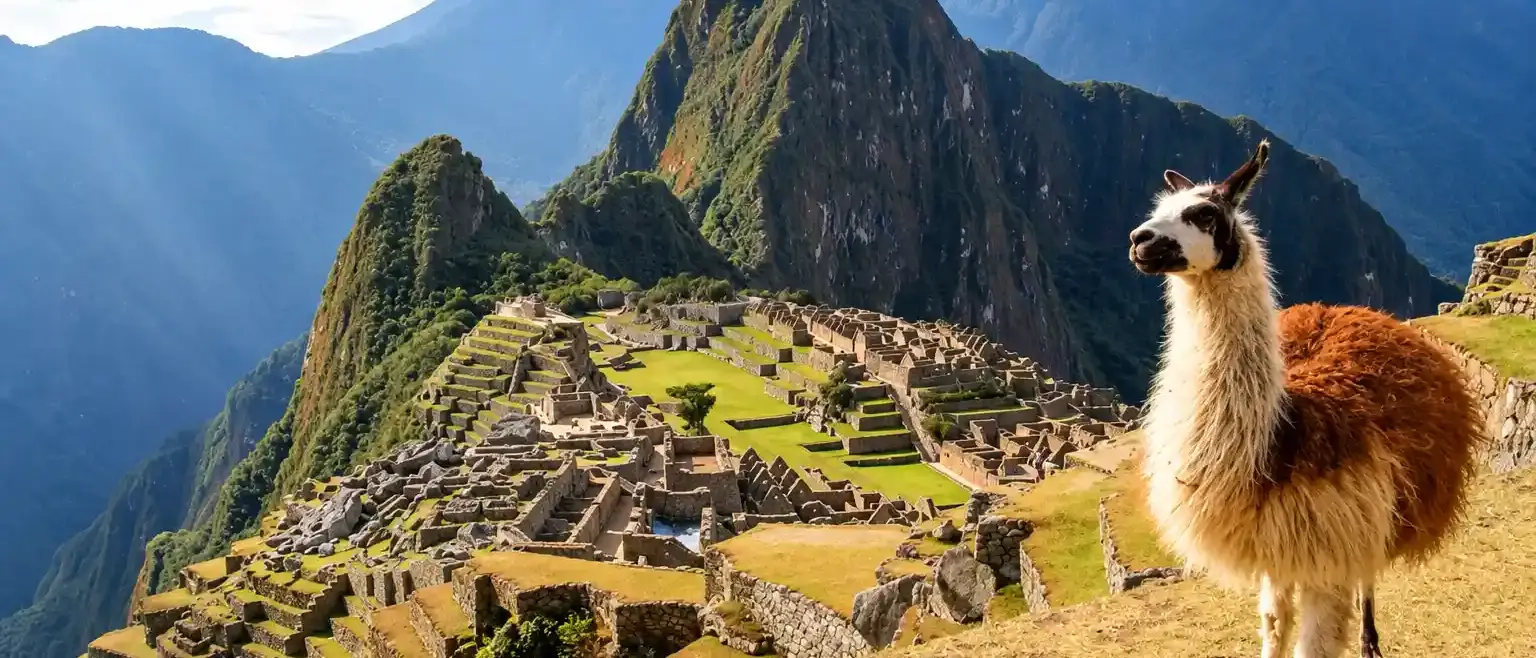
Huayna Picchu: Tickets, the Hike and Is It Worth It?

Huayna Picchu is the steep peak behind Machu Picchu, 2,693 m high. You climb it with a route 3-A ticket: S/ 200 for a foreign adult, about US$58, with entry at 7 or 10 a.m. and only 400 places a day. The climb takes about an hour up. It is worth it if you are fit and steep drops don't scare you.
- 2,693 m
- summit, 8,835 ft
- S/ 200
- route 3-A, about US$58
- 400 a day
- entry at 7 or 10 a.m.
- 1 hour
- to the top, on stone stairs
In this guide
What Is Huayna Picchu?
Huayna Picchu is the pointed mountain in every classic photo of Machu Picchu. It rises at the northern end of the ridge, right behind the Inca city, and stands 263 m above it.
The name is Quechua. Wayna means young and picchu a peak, so it is the "young peak", in contrast with Machu Picchu, the "old peak" to the south. The Ministry of Culture writes it as one word: Waynapicchu.
It is not just a viewpoint. The Incas built terraces, small buildings and a long stone stairway to the top, with some steps carved straight into the rock. The Ministry describes it as a sacred and astronomical site, with a view of the great snowcapped mountains of Cusco.

Huayna Picchu Tickets: Which Circuit Includes the Climb
Huayna Picchu is route 3-A of Circuit 3. There is no ticket for the mountain alone: the same ticket takes you through the lower part of the city first, then to the mountain gate beside the Sacred Rock.
| Visitor | Route 3-A ticket |
|---|---|
| Foreign adult | S/ 200, about US$58 |
| Peruvian or Andean Community citizen | S/ 112 |
| Peruvian or Andean Community student or child | S/ 80 |
| Children under 3 | Free |
Prices for 2026. A foreign card pays a fee of about 4.7% on top. Without the mountain, a foreign adult pays S/ 152.
How to buy them
- Go to the official site, tuboleto.cultura.pe, and choose Circuit 3, route 3-A, the date and the entry hour.
- Enter each visitor's passport number. The ticket is tied to that document and is checked at the gate.
- Pay by card within 15 minutes. Since September 2026 there are no reservations: a ticket is yours only once it is paid.
Right now tickets are on sale up to December 31, 2026. On October 14, 2026 the minister of culture announced sales a full year ahead, but no date has been set yet.
The visit to the city is done with a licensed guide, one for every eight visitors. The guide walks you to the mountain gate and you climb on your own. Only a private tour that pays for a guided climb takes the guide to the top.
Entry Times and Daily Limits
- 400
- climbers a day
- 7:00
- first group, 200 places
- 10:00
- second group, 200 places
- 6 hours
- maximum on route 3-A
Each group has 30 minutes to pass the mountain gate: from 7:00 to 7:30 or from 10:00 to 10:30. Staff register you in and out, and everyone must be back down from the summit by 1 p.m.
The rule that catches people out: there is no grace period at the mountain gate. The main entrance allows 30 minutes of delay, 45 in high season, but if you reach the Huayna Picchu gate after your slot, you lose the climb.
- One route per ticket. You can't switch to the Great Cave or Huchuy Picchu routes, and you can't enter again after you leave.
- Sold out early. In the dry season, from May to September, buy as soon as you know your dates. Most visitors want the 7 a.m. group.
- Closed in June 2026. The mountain closed from June 1 to 30, 2026 for maintenance and reopened on July 1. The Ministry has not said whether this will happen again in 2027.
The Huayna Picchu Hike Step by Step
The climb starts at the north end of the city, beside the Sacred Rock. From the gate a narrow stone stairway climbs the mountain's south face, through cloud forest and Inca terraces.
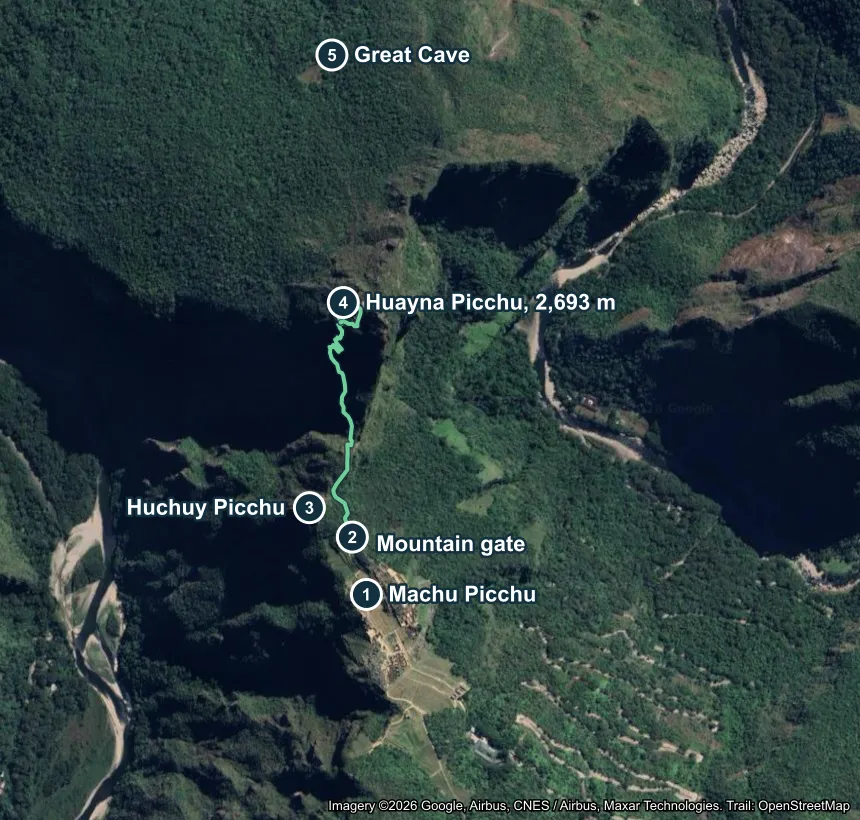
- The mountain gateShow your ticket and passport and sign the register beside the Sacred Rock.
- The lower stairwayUneven stone steps, most of them with a handrail or a steel cable since July 2026.
- The upper terracesInca walls and small buildings clinging to the slope, just below the top.
- The tiny stepsAbout 100 m of very narrow steps near the summit. Many people use their hands.
- The summitA pile of large boulders 2,693 m up, with the whole city laid out below.
Most people reach the top in 45 to 60 minutes and take about as long to come down. The Ministry counts on about 3 hours from the moment you pass the gate until you sign out again, with stops for photos.
Nobody has made an official count of the steps. The "750 steps" you see online has no source. Expect hundreds of uneven stone steps, some high and some barely wider than your foot.

The Stairs of Death: How Scary Are They?
"Stairs of Death" is a nickname, not an official name. It refers to the steep, narrow stairs near the top, where the terraces end in a sheer drop to the Urubamba river hundreds of meters below.
The name comes from the drop you see, not from accidents. We found no reliable record of anyone dying on those stairs. On a dry day, walking slowly and holding the cable, they are steep rather than dangerous.
Accidents on record
- 1997. A 68 year old American hiker lost her balance on the way to the top and fell (UPI news agency).
- 2014. A 65 year old Belgian visitor died at the summit of a suspected heart attack (Cusco tourism police).
- 2019. A visitor slipped on the way down and fell about 4 m, with minor injuries (Ministry of Culture).
- 2021. An American visitor died of natural causes at the gate, on the way out (Ministry of Culture).
The widely shared story of a tourist who fell while taking a selfie happened on Machu Picchu Mountain, not on Huayna Picchu.
Huayna Picchu Elevation and Difficulty
The summit stands at 2,693 m (8,835 ft), 263 m above the city. Some websites say 2,720 m, but no official source backs that figure. The height of 2,693 m comes from OpenStreetMap and the Peakbagger survey of the peak.
From Aguas Calientes to the top of Huayna Picchu
Machu Picchu Mountain, 3,082 m (10,111 ft), the other climb
- 1Aguas Calientes2,040 m (6,693 ft)25 minutes up by bus
- 2Machu Picchu2,430 m (7,972 ft)The city and the mountain gate
- 3Huayna Picchu2,693 m (8,835 ft)About 1 hour on foot
We rate it moderate to challenging. Not because of the altitude: by the time you reach Machu Picchu you have come down from Cusco, and our travelers climb without altitude trouble. What makes it hard is the steepness.
- Fitness. The Ministry asks for good physical condition. If you can climb ten floors of stairs with a few short stops, you can do it.
- Knees. The way down is harder on the knees than the way up. Take it slowly.
- Heart and lungs. Ask your doctor first if you have a heart or breathing condition. The only deaths recorded in recent years had natural causes.
- Age. There is no minimum age, but we recommend it for children over 12.
The Temple of the Moon and the Great Cave
Hidden on the back of the mountain, at about 2,266 m, is a set of caves lined with fine Inca stonework. The main one is about 12 m deep and 7 m wide, with false doorways and trapezoidal niches cut to fit the living rock.
It is known as the Temple of the Moon, but archaeologists prefer the name Great Cave. The cave faces west while the moon rises in the east, and nothing found there points to a moon cult. A study started in 2026 is testing whether it was a tomb for the Inca elite.
| Route 3-C | Great Cave |
|---|---|
| Places | 50 a day |
| Entry | 8 and 9 a.m. |
| Maximum time | 7 hours |
| Season | High season only |
In 2026 the high season covers January 1, April 2 to 5, June 19 to November 2, and December 30 and 31.
You can't reach the cave on a Huayna Picchu ticket. Since 2024 it has its own route, 3-C, and the gates do not let you switch routes. If the cave is what you want, book route 3-C: a longer and much quieter day.
Huayna Picchu or Machu Picchu Mountain: Which One to Choose?
Both cost the same, S/ 200, and both sell out. They suit different people. A third option, Huchuy Picchu, is the small peak in front of Huayna Picchu.
| Huayna Picchu | Machu Picchu Mountain | Huchuy Picchu | |
|---|---|---|---|
| Route | 3-A | 1-A | 3-D |
| Summit | 2,693 m | 3,082 m | 2,497 m |
| Above the city | 263 m | 652 m | 67 m |
| Round trip | 1.5 to 2 hours | 3 to 4 hours | About 1 hour |
| Exposure | High: narrow steps, steep drops | Moderate: wider path | Low |
| The view | Close, from above the city | Wide, from far above | Close, from the north |
| Places and entry | 400, at 7 and 10 a.m. | 350, at 7 and 9 a.m. | 40, at 9 and 11 a.m., high season |
- You want the iconic climb
Huayna Picchu
Short, steep and exciting, with the city right below you.
- Heights make you nervous
Machu Picchu Mountain
Longer and higher, on a wider and safer path.
- Families or short on time
Huchuy Picchu
A short walk to a quiet viewpoint. Only in high season.
- Your first visit
Circuit 2 first
If you can only buy one ticket, the full city tour shows more.

Best Time of Day and Season to Climb
The 7 a.m. group climbs in cool air and has more time before the 1 p.m. limit. Mornings are often cloudy, though, and the city may be hidden when you reach the top. Waiting there for the clouds to lift is part of the experience.
The 10 a.m. group usually gets clearer skies and more sun on the stairs. You have about 3 hours before the deadline, which is enough, but there is less room for long breaks at the summit.
The best season is the dry season, from May to September. From November to March the rain makes the stones slippery and the climb much harder. Bring shoes with a good grip whatever the month.
To make the 7 a.m. group you need to sleep in Aguas Calientes the night before. Trains and times are in our guide on how to get to Machu Picchu from Cusco.
What to Bring
- Your passport, the original you used to buy the ticket. It is checked at the main entrance and at the mountain gate.
- Water. There is none on the trail. Food is not allowed inside the site.
- Shoes with a good grip. Hiking shoes or trail runners, never smooth soles.
- A light rain jacket and a warm layer. The weather changes fast at the top.
- Sun protection and insect repellent. The sun is strong and the little sand flies bite.
- A small backpack, no larger than 40 by 35 by 20 cm.
Machu Picchu tours where you can add Huayna Picchu
 Sacred Valley and Machu Picchu2 days · EasyFrom $390
 Machu Picchu Private 3 Days3 days · EasyFrom $830
 Salkantay Trek 5 Days5 days · ChallengingFrom $310


Frequently Asked Questions
Is Huayna Picchu worth it?
Yes, for fit travelers without a strong fear of heights. It gives the best view straight down onto the city. Remember that route 3-A skips the Sacred Plaza and the Intihuatana.
How long does the Huayna Picchu hike take?
About 45 to 60 minutes up and the same down. Count on about 3 hours from the mountain gate and back, with time at the top.
Can you climb Huayna Picchu without a ticket?
No. You need a route 3-A ticket for that day and hour. Staff check it with your passport at the mountain gate.
How much does a Huayna Picchu ticket cost?
S/ 200 for a foreign adult in 2026, about US$58, plus a card fee. It includes the visit to the lower part of the city.
Has anyone died on Huayna Picchu?
Very few people. One hiker died in a fall in 1997. The deaths since then were from heart attacks or natural causes. No death has been recorded on the so called Stairs of Death.
Is there an age limit for Huayna Picchu?
There is no official minimum age. We recommend the climb for children over 12, who can handle the high steps and the drops.
Does my guide climb Huayna Picchu with me?
No. Your guide shows you the city and takes you to the mountain gate. You climb on your own, unless you book a private tour with a guided climb.
Can I see the Temple of the Moon from Huayna Picchu?
Not on the same ticket. The Temple of the Moon, or Great Cave, has its own route, 3-C, open only in high season for 50 people a day.
How we checked this guide
This guide comes from what we see while guiding these routes every week. Prices, schedules and rules were checked against the official sites below.
We sell the Machu Picchu tours linked on this page and can add a Huayna Picchu ticket to them. Routes, times and prices come from the Ministry of Culture and were checked on the date above.
- Ministry of Culture, circuits and visiting routes (official map of route 3-A)
- Ministry of Culture, official ticket site
- OpenStreetMap, Huayna Picchu peak and trails
Last checked:

Jorge Suyo
Director and trekking guideJorge Suyo is a trekking guide and the person who leads Inca Outdoors. He knows these trails from walking them with groups, and that experience shapes how each trip is planned.
Meet the team

