


Machu Picchu Facts: What It Is Known For, Its Temples and the Myths That Are Not True

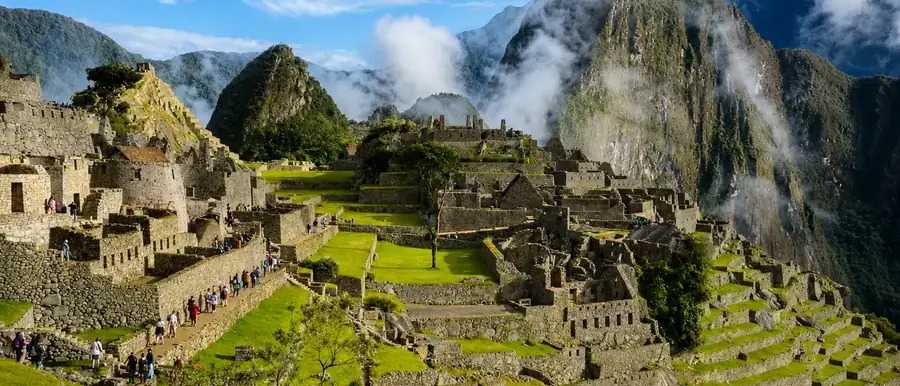
Machu Picchu is a 15th century Inca royal estate on a ridge at about 2,430 m (7,970 ft) in the Peruvian Andes. Radiocarbon dates published in 2021 show people lived there from about 1420 to 1530. The city covers about 10 to 12 hectares, sits inside a protected sanctuary of 32,592 hectares and has been a UNESCO World Heritage Site since 1983.
- 2,430 m
- height of the city (7,970 ft)
- 10 to 12 ha
- size of the city (25 to 30 acres)
- 700+
- stone terraces
- 1,542,350
- visitors in 2025
In this guide
Machu Picchu facts at a glance
Most "facts" about Machu Picchu online are copied from one blog to the next. We checked the ones below against UNESCO, the Peruvian Ministry of Culture, the protected areas service SERNANP and peer reviewed studies. Where official sources disagree, we say so.
| Fact | Answer | Source |
|---|---|---|
| Built for | Inca ruler Pachacuti, as a royal estate | 1568 land document (Rowe, 1990) |
| Lived in | About 1420 to 1530 | 26 radiocarbon dates (Antiquity, 2021) |
| Height | About 2,430 m (7,970 ft) | Kenneth Wright; UNESCO says "over 2,400 m" |
| Size of the city | About 10 to 12 ha (25 to 30 acres) | Ministry of Culture |
| Protected sanctuary | 32,592 ha (about 80,500 acres) | Supreme Decree of 1981, SERNANP |
| People living there | 500 to 750 at the busiest time of year | Bauer; Salazar and others (2023) |
| Shown to the world | 24 July 1911, by Hiram Bingham | Yale expedition records |
| World Heritage Site | Since December 1983 | UNESCO, site no. 274 |
| New Seven Wonders | Since 7 July 2007 | New7Wonders vote (not UNESCO) |
| Daily visitor limit 2026 | 4,500, or 5,600 on peak dates | Ministerial Resolution 285-2025-MC |
The official spelling in Peru is Machupicchu, written as one word. Its official name is the Llaqta de Machupicchu, the settlement of Machu Picchu.
What is Machu Picchu known for?
Machu Picchu is known for three things at once: an Inca city that survived almost intact, a setting on a ridge ringed by cloud forest and peaks, and engineering that has kept it standing on steep ground for more than 500 years.
- It was never destroyed. The Spanish knew of "Picchu" from 1568 documents but never looted or rebuilt it, unlike Cusco, where churches stand on Inca walls.
- Its setting. UNESCO lists it as both a cultural and a natural site, one of few in the world, because the forest around the stones is protected too.
- Its engineering. Stone fitted without mortar, more than 700 terraces and a drainage system that, according to engineer Kenneth Wright, is the main reason the city still stands.
Who built it, when and why, step by step, is a story of its own. Here we stay with the facts you will see and hear on the ground.
How big is Machu Picchu?
The city itself covers about 10 to 12 hectares, or 25 to 30 acres: roughly the size of 15 soccer fields. The Ministry of Culture uses 12 ha; its own archaeologists Fernando Astete and José Bastante write "about ten". An official boundary drawn in 2014 measured 12.2 ha with a perimeter of 7,925 m.
- 10 to 12 ha
- the city (llaqta)
- 4.9 ha
- of farming terraces (Wright)
- 32,592 ha
- Historic Sanctuary, legal area of 1981
- 60+
- archaeological sites in the park
The Historic Sanctuary around it is far larger. Its legal area from 1981 is 32,592 ha, while the Ministry of Culture now gives 37,302 ha for the archaeological park after later boundary changes. It holds more than 60 archaeological sites, the Inca Trail among them.
How many steps does Machu Picchu have?
Nobody has an official count. The "3,000 steps" and "109 staircases" you read on travel sites have no source behind them. What is certain: every visit means many stone stairs, so wear shoes with a good grip.
Is Machu Picchu one of the Seven Wonders of the World?
Yes. On 7 July 2007, in Lisbon, Machu Picchu was named one of the New Seven Wonders of the World, alongside the Great Wall of China, Petra, the Colosseum, Chichén Itzá, the Taj Mahal and Christ the Redeemer.
That title came from a public vote run by the private New7Wonders foundation, not from UNESCO. UNESCO said in June 2007 that it had no link with the campaign and chose not to take part.
The Historic Sanctuary of Machu Picchu and UNESCO
- 8 January 1981: Peru creates the Historic Sanctuary of Machu Picchu, 32,592 ha, by Supreme Decree 001-81-AA.
- December 1983: UNESCO inscribes it as World Heritage site no. 274, for both its culture and its nature.
The UNESCO listing is what actually protects the site. In 2025 the World Heritage Committee voiced concern about visitor numbers, after Peru's comptroller found 91,836 entries above the daily limit across 2024 and 2025.
The temples of Machu Picchu and where you see them
The Incas left no writing, so every temple name and function is an archaeologist's reading, many of them given in the 20th century. Only one building, the Temple of the Sun, has been studied in depth as an observatory.
Temples on the plan of Machu Picchu
- 1Temple of the SunRoyal Tomb below
- 2Quarry
- 3Sacred PlazaMain Temple, Three Windows
- 4Intihuatana
- 5Sacred Rock
- 6Temple of the Condor
© OpenStreetMap contributors
| Temple | What it was | Where you see it |
|---|---|---|
| Temple of the Sun | Curved tower built on a sacred rock; solar observatory | Circuit 2 from above, Circuit 3 up close |
| Royal Tomb | Cave with carved niches under the tower; no royal burial found | Route 3-B, from outside |
| Temple of the Three Windows | Wall with three large windows facing east | Circuit 2 |
| Main Temple | Three walled hall with a great stone altar | Circuit 2 |
| Intihuatana | Carved granite outcrop, an altar or huaca | Circuit 2, from below only |
| Temple of the Condor | Natural rock read as a condor with spread wings | Circuits 2 and 3 |
Inside the ruins you walk with a licensed guide, one per eight visitors. How the three circuits run is in our Machu Picchu map.
Temple of the Sun at Machu Picchu
The Temple of the Sun, or Torreón, is a curved stone tower built over a sacred rock, with some of the finest masonry in the city. At the June solstice, the first light of morning enters through its east window and lines up with a cut in the rock below.

Polish archaeologists Jacek Kościuk and Mariusz Ziółkowski measured those alignments and published the study in 2020. It is the only temple at Machu Picchu with solid astronomical research behind its function.
Under the tower is a cave with carved niches, called the Royal Tomb. No royal burial was ever found there; it is read as a place for ceremonies. Visitors see the tower from outside: from above on Circuit 2 and close up on route 3-B.
The Intihuatana stone
The Intihuatana is a carved granite outcrop on top of a stepped hill at the highest point of the sacred sector. It is read as an altar or huaca, a sacred place, perhaps with uses tied to the sun.

Two popular claims need care. The name, "the place where the sun is tied", is modern, not Inca. And calling it a sundial is a simplification that no study supports. Today no route climbs the hill: you see it from below on Circuit 2.
The Temple of the Condor
The Temple of the Condor is a group of natural rocks and Inca walls that together look like a condor with spread wings, with a carved stone on the ground often read as its head. Small caves open under the rocks.

The condor was one of the sacred animals of the Andes, so the reading makes sense, but it remains an interpretation. Wright's team found that water from this sector drains through caves underground, part of the hidden drainage that protects the city. You see it on Circuits 2 and 3.
The Sacred Plaza, the Three Windows and the Sacred Rock
The Sacred Plaza is the ceremonial heart of the city. On one side stands the Main Temple, a hall with three walls and a large stone altar. On another stands the Temple of the Three Windows, a fine wall with three big trapezoid windows that look east over the valley.
In 1911 Hiram Bingham found a name written in charcoal on one of its walls: "Lizárraga 1902", left by a Cusco farmer who reached the ruins nine years before him. The popular idea that the three windows stand for the three Inca worlds has no documentary source.
At the far end of the city, the Sacred Rock is a flat slab whose outline echoes the mountains behind it. It marks the start of the trail up Huayna Picchu, covered in our Huayna Picchu guide.
The Sun Gate (Inti Punku)
The Sun Gate, Inti Punku in Quechua, is a stone gateway on the ridge southeast of the city, at about 2,720 m (8,920 ft). It was the entrance of the Inca road from Cusco and is read as a control point. From it you get the classic first view of Machu Picchu with Huayna Picchu behind.

- From the city: route 1-C, about 3.4 km there and back and about 2 hours, with entry from 7 to 10 a.m. in the high season.
- On foot from Cusco: it is the finish of the Classic Inca Trail in 4 days and the Short Inca Trail in 2 days.
You will often read that the sun rises through the gate at the June solstice. We found no archaeoastronomy study that backs it, so treat it as a guide's story.
The Temple of the Moon (the Great Cave)
The Temple of the Moon is a set of fine stone walls, niches and doorways built inside a natural cave on the north face of Huayna Picchu, below the level of the city. Archaeologists call it the Great Cave.

The name is not Inca. Former park director Fernando Astete and archaeologist Julinho Zapata have said there is no archaeological evidence of a moon cult there; archaeologist Rolando Pizarro says visitors named it for the way full moon light fills the cave. The leading theory is an elite tomb, looted long ago, and in 2026 a team began probing it with an endoscope.
It is reached on route 3-C, which admits 50 people a day at 8 and 9 a.m. in the high season.
Machu Picchu stones: how the walls were built
Every wall is white granite quarried on the ridge itself, and the quarry is still there inside the city. The Incas built two kinds of wall: fine ashlar, blocks cut to fit each other perfectly, for temples and royal buildings, and rougher walls of smaller stones for houses and terraces.

- "Not even a credit card fits between the stones." True for the fine ashlar of the main buildings, not for most of the city.
- "60 percent is underground." Kenneth Wright's estimate of the building effort spent on foundations and drains. An expert estimate, not a measurement.
- "The stones dance in earthquakes." The city sits between two faults and dry walls take shaking well, but no seismic study has proved the dancing stones.
Wright counted 129 drain outlets, a 749 m channel from a spring and 16 stone fountains in a row. The spring still runs into the fountains today.
Are there llamas at Machu Picchu?
Yes. A small herd grazes the terraces, and the llamas are free to wander among visitors. Guides and park staff say they were brought in during the 1980s and that park workers look after them, with numbers usually given as 15 to 30. We found no official record of when they arrived.

Did the Incas keep llamas here? The animal remains Yale excavated in 1912 have been studied, but the clearest result is about dogs: anthropologist John Verano found dog burials in the caves, including a woman buried with a small Inca dog.
How do you pronounce and spell Machu Picchu?
Say "MAH-choo PEEK-choo", with a clear k in the second word. In Quechua the name is Machu Pikchu: machu means "old" and pikchu a peak, so "Old Peak".
- Spelling: Machu Picchu, with a double c. Peru's official form is Machupicchu, one word.
- "Machu Pichu" without the k sound is the most common mistake in English. Both pronunciations appear in dictionaries, but the k is closer to the original.
- A guide's joke claims "pichu" means something rude in Quechua. No Quechua dictionary records it.
The Incas probably called the place by another name. A 2022 study by historian Donato Amado Gonzales and archaeologist Brian Bauer concludes it was Picchu, or more likely Huayna Picchu.
Wildlife and orchids around Machu Picchu
The Historic Sanctuary climbs from about 1,800 to 6,000 m, from cloud forest to the glaciers of the Salkantay range. That range packs in a striking variety of life.

- More than 400 orchid species, according to SERNANP. A new one, Pleurothallis machupicchuensis, was described in 2025.
- The Andean cock of the rock, Peru's national bird, with its bright orange males, often seen near the Urubamba river.
- The spectacled bear, the only bear in South America, which lives in the sanctuary's forests but is rarely seen.

Orchids flower most in the rainy season, from December to March, which our guides consider the best time for nature lovers. The trail that meets the most species is the Short Inca Trail, through cloud forest.
Fun facts about Machu Picchu
- Hiram Bingham was governor of Connecticut for one day, 7 to 8 January 1925, before leaving for the US Senate.
- One tourist had the city to himself. Jesse Katayama, from Japan, waited seven months during the 2020 lockdown and was let in alone on 10 October 2020.
- The town below is not officially called Aguas Calientes. Its legal name since 1941 is Machupicchu Pueblo, and it began as a railway camp in 1928.
- A Werner Herzog film was shot on Huayna Picchu. The opening of Aguirre, the Wrath of God (1972) was filmed on its stone stairway.
- About 78 percent of visitors are foreigners, according to Peru's tourism ministry for January to September 2025.
- Two farming families were living there in 1911, the Richarte and Álvarez families, growing crops on the Inca terraces.
- The record year is 2019, with 1,585,262 visitors. 2025 came close with 1,542,350.
- The Incas had dogs here, buried with their owners in the caves around the city.

Machu Picchu myths: aliens, gold and the Virgins of the Sun
| Myth | What the sources say |
|---|---|
| Aliens built it | No serious source. The Inca engineering is documented in detail, down to the drains |
| Gold is hidden there | The idea comes mainly from an 1887 brochure for Augusto Berns's treasure company. No gold hoard was ever found |
| Secret tunnels run under it | No archaeological evidence. The only tunnel nearby is a modern hydroelectric channel |
| It was a home for the Virgins of the Sun | Bingham's team counted four women per man among the skeletons. John Verano's reexamination for Yale (2003) found about 1.5 to 1 |
| Human sacrifices took place here | No published evidence. Verano found few injuries on the skeletons |
| It is the lost city of the Incas | Bingham believed so. The last Inca city, Vilcabamba, is Espíritu Pampa |
| Bingham inspired Indiana Jones | Not documented. The costume designer of the 1981 film points to Charlton Heston in Secret of the Incas (1954) |
See Machu Picchu with a guide
 Sacred Valley and Machu Picchu2 days · EasyFrom $390
 Classic Inca Trail 4 Days4 days · ChallengingFrom $750
 Machu Picchu Private 3 Days3 days · EasyFrom $830


Frequently Asked Questions
What is Machu Picchu in short?
A 15th century Inca royal estate built for the ruler Pachacuti on a ridge at about 2,430 m in Peru. Today it is the best known Inca site in the world and a UNESCO World Heritage Site since 1983.
How many people visit Machu Picchu every year?
1,542,350 in 2025, close to the record of 1,585,262 in 2019. In 2026 the daily limit is 4,500 people, or 5,600 on peak dates.
Is Machu Picchu a UNESCO World Heritage Site?
Yes, since December 1983, as site no. 274, for both its culture and its nature. Its "New Seven Wonders" title of 2007 is separate and not from UNESCO.
Can you visit the Sun Gate without hiking the Inca Trail?
Yes. Route 1-C walks from the city to the Sun Gate and back in about 2 hours, with entry from 7 to 10 a.m. in the high season.
Can you go up to the Intihuatana stone?
No. No route climbs the hill anymore. You see the Intihuatana from below on Circuit 2.
Is the Temple of the Moon a real temple?
It is a real Inca structure inside a cave, but the name is modern. Archaeologists find no sign of a moon cult and think it was an elite tomb.
Do you need a guide at Machu Picchu?
Yes. Visits inside the city are made with a licensed guide, one per eight visitors.
How do you say Machu Picchu?
"MAH-choo PEEK-choo", with the k. In Quechua it is Machu Pikchu, "Old Peak".
How we checked this guide
This guide comes from what we see while guiding these routes every week. Prices, schedules and rules were checked against the official sites below.
We run guided tours and treks to Machu Picchu, including the Inca Trail to the Sun Gate. The facts come from UNESCO, the Peruvian Ministry of Culture, SERNANP and published research; we checked them on the date above.
- UNESCO: Historic Sanctuary of Machu Picchu
- Burger and others, "New AMS dates for Machu Picchu", Antiquity, 2021
- Salazar and others, genetic study of the residents, Science Advances, 2023
- Wright and others, "The Masterful Water Engineers of Machu Picchu", Water, 2021
- Peruvian Ministry of Culture, official Machu Picchu tickets
Last checked:

Jorge Suyo
Director and trekking guideJorge Suyo is a trekking guide and the person who leads Inca Outdoors. He knows these trails from walking them with groups, and that experience shapes how each trip is planned.
Meet the team

